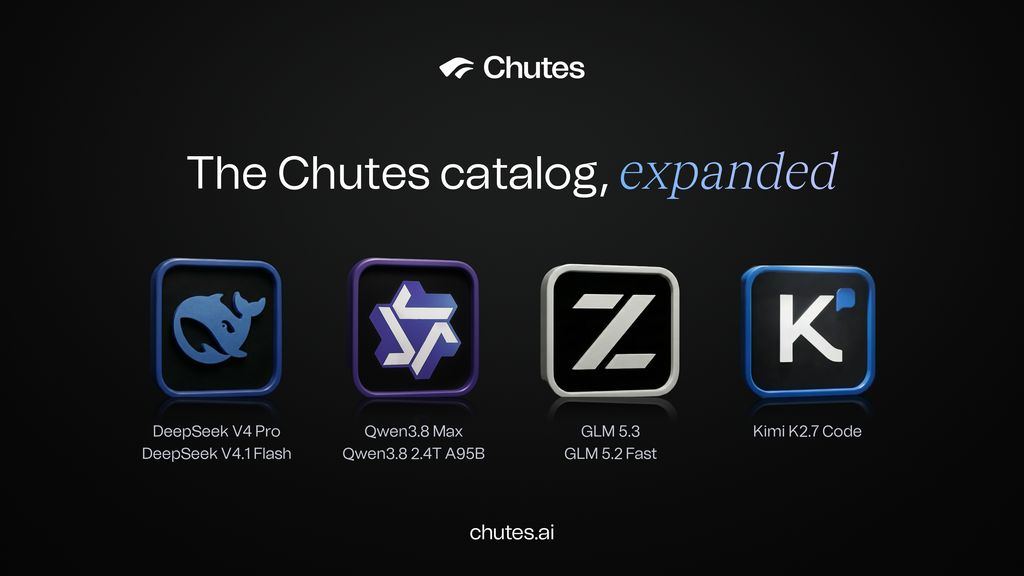
We’re expanding our model catalog with GLM, DeepSeek, Qwen, and Kimi
Timon Agar
Engineering and product team.
We’ve added seven models from Z.ai, DeepSeek, Alibaba’s Qwen team, and Moonshot AI to our catalog. The lineup includes GLM-5.3, DeepSeek V4.1 Flash 1017, and Kimi K2.7 Code, all accessible through our OpenAI-compatible API with an existing key and account credits.
You can compare models for coding, research, and agent workflows without setting up a separate provider integration. Regular input prices start at $0.30 per million tokens, with the full lineup and rates below.
TL;DR
- Seven additional models work with our existing API base URL, your current key, and your account credits.
- DeepSeek V4.1 Flash 1017 has the lowest listed token rates in this expansion, starting at $0.30 per million regular input tokens.
- Compare model capabilities, API IDs, and launch pricing below, then get started with the Python or curl example.
Which models are joining our catalog?
Prices are US dollars per million tokens, shown as regular input / cached input / output. These are our launch rates, as listed on our model pages on October 29, 2026. Cached rates apply only to eligible tokens.
| Model | API model ID | Use cases to evaluate | Price per million tokens |
|---|---|---|---|
| GLM-5.3 | zai-org/GLM-5.3 | Complex coding and long agent tasks | $1.225 / $0.245 / $3.85 |
| DeepSeek V4.1 Flash 1017 | deepseek-ai/DeepSeek-V4.1-Flash-1017 | Budget-conscious coding and prototypes | $0.30 / $0.03 / $1.20 |
| GLM-5.2 Fast | zai-org/GLM-5.2-Fast | Long-running coding workflows | $2.45 / $0.49 / $7.70 |
| Qwen3.8 Max 0902 | Qwen/Qwen3.8-Max-0902 | Engineering projects and tool orchestration | $2.00 / $0.25 / $6.00 |
| DeepSeek V4 Pro 0813 | deepseek-ai/DeepSeek-V4-Pro-0813 | Coding agents and complex reasoning | $0.85 / $0.15 / $2.65 |
| Kimi K2.7 Code | moonshotai/Kimi-K2.7-Code | Software engineering agents | $0.832 / $0.167 / $3.50 |
| Qwen3.8 2.4T A95B | Qwen/Qwen3.8-2.4T-A95B | Text-based coding, research and agent tasks | $2.00 / $0.25 / $6.00 |
The descriptions draw on model makers’ documentation. Published model capabilities do not establish the context limits or features enabled on each of our endpoints.
GLM-5.3
GLM-5.3 builds on GLM-5.2’s base model through post-training improvements focused on complex coding and extended software-engineering tasks. Z.ai’s model card reports gains on repository-level coding and vulnerability-discovery evaluations. For developers comparing the two GLM releases, it offers a newer coding model at half GLM-5.2 Fast’s listed launch rates for regular input, cached input, and output.
DeepSeek V4.1 Flash 1017
DeepSeek V4.1 Flash 1017 has the lowest listed token rates in this expansion, making it a useful starting point for budget-conscious applications and repeated coding requests. DeepSeek’s model card reports shorter outputs and reduced task-execution time compared with the preceding V4.1 Flash release.
GLM-5.2 Fast
GLM-5.2 Fast provides an option for developers who already use GLM-5.2 and want to evaluate another endpoint before changing model versions. Z.ai’s documentation for the underlying model emphasizes sustained coding work across extended tasks. With Fast’s listed token rates twice those of GLM-5.3, the choice depends on its results with your existing prompts rather than its name alone.
Qwen3.8 Max 0902
Qwen3.8 Max 0902 focuses on engineering projects that require coordination across multiple tools and agents. Alibaba’s description of this September snapshot highlights improvements in multi-tool orchestration and autonomous development over the earlier Max release. That makes repository workflows involving file inspection, code changes, test execution, and follow-up fixes a useful evaluation target.
DeepSeek V4 Pro 0813
DeepSeek V4 Pro 0813 is the full release of V4 Pro, replacing its earlier preview. DeepSeek’s evaluations include dedicated tests for full-stack development and difficult coding-agent problems, with improvements over that preview. It provides a higher-priced comparison point to Flash for demanding implementation work. Evaluating both on repository changes with clear acceptance tests can show whether Pro’s results justify the additional token cost; the published comparisons do not establish an advantage over V4.1 Flash 1017.
Kimi K2.7 Code
Kimi K2.7 Code combines a focus on extended software-engineering tasks with reduced reasoning-token usage. Moonshot AI’s model card reports approximately 30% fewer thinking tokens than Kimi K2.6, the model it builds on. This makes it relevant to coding sessions where repeated reasoning contributes substantially to total token usage. The reported reduction is relative to Kimi K2.6, so compare tokens per successfully completed task before assuming similar savings against other models.
Qwen3.8 2.4T A95B
Qwen3.8 2.4T A95B is a text-only mixture-of-experts model with 2.4 trillion total parameters and 95 billion activated per token. Alibaba’s model card specifies that it uses thinking mode for every interaction, distinguishing it from the broader Qwen3.8 Max service. Its documented focus includes research and extended coding tasks, making it a candidate for text-based workflows that require multi-step reasoning. Both Qwen entries have the same listed token rates, so answer quality and total token usage are useful deciding factors. Upstream reasoning controls should not be assumed available on our endpoint without confirmation.
Call a model through our API
Use an existing key or create one in API key settings. Add account credits and set CHUTES_API_KEY in your environment, outside source code.
Use https://llm.chutes.ai/v1 as the base URL. Change the model ID to switch available endpoints while retaining the URL and key.
Python
Install the OpenAI SDK. The example was verified with version 3.40.0.
python -m pip install openai==3.40.0
Save the following as quickstart.py, then run python quickstart.py in the environment containing your key.
import os
from openai import OpenAI

client = OpenAI(
    api_key=os.environ['CHUTES_API_KEY'],
    base_url='https://llm.chutes.ai/v1',
    max_retries=0,
    timeout=120,
)
response = client.chat.completions.create(
    model='deepseek-ai/DeepSeek-V4.1-Flash-1017',
    messages=[{'role': 'user', 'content': 'Reply with exactly: CHUTES_OK'}],
    temperature=0,
    max_tokens=1024,
)
choice = response.choices[0]
if choice.finish_reason != 'stop' or not (choice.message.content or '').strip():
    raise RuntimeError('No naturally completed visible answer; inspect the response.')
print(choice.message.content)
The verified response was CHUTES_OK. Retries are disabled, and completion is checked. Longer reasoning tasks may need more than 1,024 output tokens.
curl
Set CHUTES_API_KEY in your shell first, then send the same prompt with curl.
curl --fail-with-body --max-time 120 \
  'https://llm.chutes.ai/v1/chat/completions' \
  -H "Authorization: Bearer ${CHUTES_API_KEY}" \
  -H 'Content-Type: application/json' \
  --data-binary '{"model":"deepseek-ai/DeepSeek-V4.1-Flash-1017","messages":[{"role":"user","content":"Reply with exactly: CHUTES_OK"}],"temperature":0,"max_tokens":1024,"stream":false}'
Check choices[0].message.content for CHUTES_OK and choices[0].finish_reason for stop. An HTTP success alone does not establish that an answer completed.
To discover other IDs, query the model discovery endpoint with GET. For coding-agent configuration, see our agent setup guide.
Pricing
Your existing account credits apply to these models. For a job using one million regular input tokens and 200,000 output tokens, the listed rates give the following costs before any cache discounts.
| Model | Input cost | Output cost | Total |
|---|---|---|---|
| DeepSeek V4.1 Flash 1017 | $0.30 | $0.24 | $0.54 |
| GLM-5.3 | $1.225 | $0.77 | $1.995, approximately $2.00 |
This example holds token usage constant. Actual usage can differ across models, so compare total request costs as well as per-token rates. Check current catalog prices before production use.
Choose a model from the table and try it with your existing Chutes key, then compare its responses and token usage on your own tasks.
FAQs
Which models are included in the expansion?
The seven additions are GLM-5.3, DeepSeek V4.1 Flash 1017, GLM-5.2 Fast, Qwen3.8 Max 0902, DeepSeek V4 Pro 0813, Kimi K2.7 Code and Qwen3.8 2.4T A95B. See the model table for API IDs and prices.
Do I need a new API key or account?
No. Your existing Chutes key and account credits work for these endpoints through https://llm.chutes.ai/v1.
Which model has the lowest token prices?
DeepSeek V4.1 Flash 1017 has the lowest listed rates in this lineup, at $0.30 for regular input, $0.03 for eligible cached input, and $1.20 for output per million tokens.
Can I use the same integration for another model?
Yes. Keep the base URL and API key, then change the model ID to an available catalog entry. Check the selected model’s supported request options before relying on model-specific features.
Need confidential compute?
These additions use standard inference and do not run inside a trusted execution environment. For workloads that require confidential compute, we also offer TEE models. Select an available model from the catalog with confidential_compute: true.